The End of the 1D Barcode Era
For over 50 years, the 1D barcode has been the standard way to identify products at retail checkout. That black-and-white stripe on every product in every store worldwide. It works, but it's limited — it can only carry a single number (the GTIN). No batch information, no expiry dates, no link to product details.
GS1 Sunrise 2027 changes this. By January 2027, all retail point-of-sale systems worldwide must accept GS1 2D barcodes (QR codes) alongside traditional 1D barcodes. After this date, 2D barcodes become the primary carrier of GS1 identifiers.
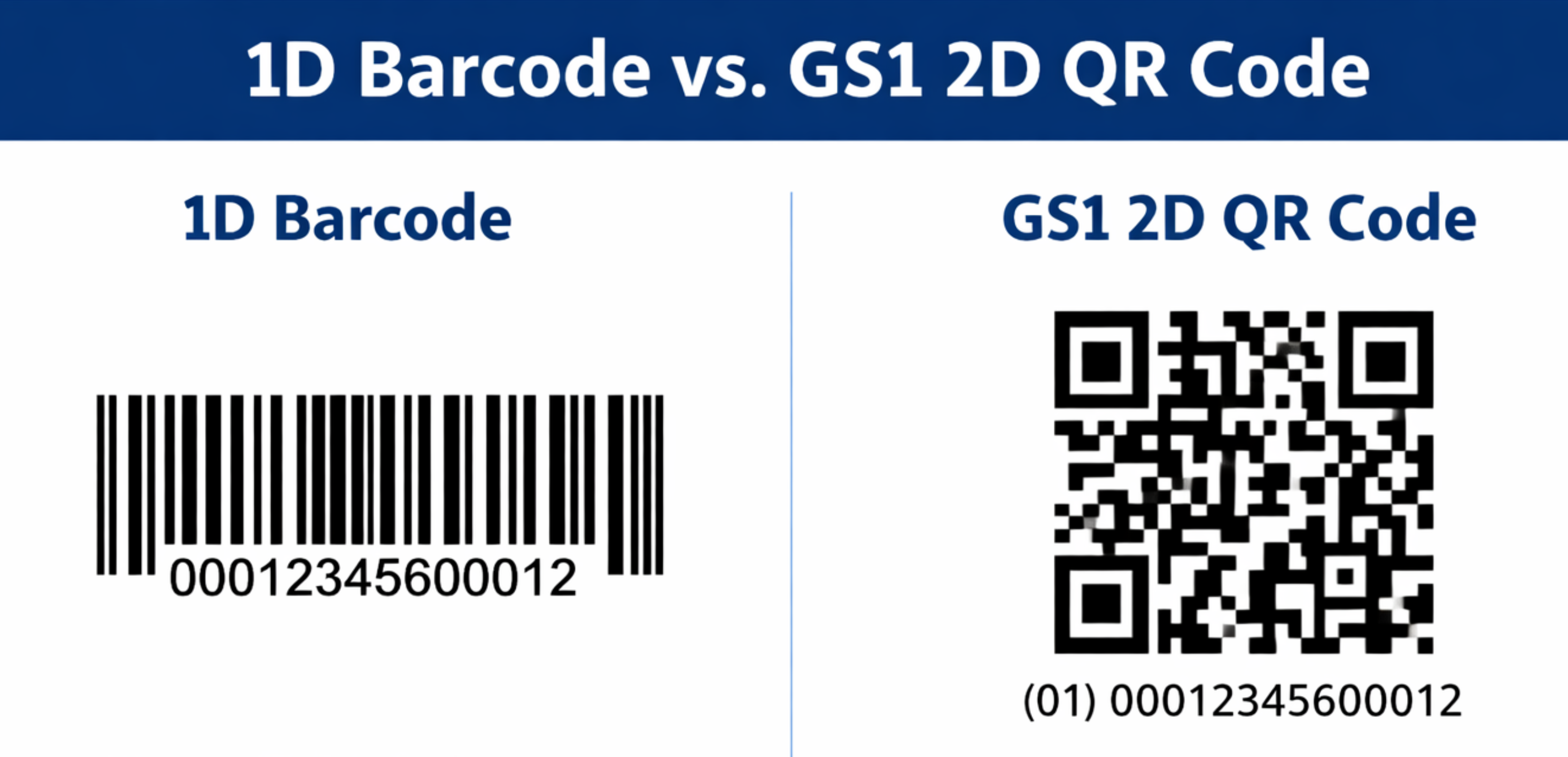
The transition from traditional 1D barcodes to GS1 2D barcodes (QR codes)
Who Is Affected?
Every business that sells physical products through retail channels. If your product has a barcode on it today, it will need a GS1 2D barcode by 2027.
| Sector | Impact | Timeline Pressure |
|---|---|---|
| FMCG / Consumer Goods | All retail-sold products need 2D barcodes | High — large SKU counts |
| Food & Beverage | Expiry dates and batch info in QR code | High — regulatory requirements |
| Pharma / Healthcare | Drug serialization, safety tracking | High — compliance critical |
| Retail / E-commerce | POS systems must accept 2D codes | Medium — system upgrades needed |
| Manufacturing | Parts and components identification | Medium — supply chain pressure |
| Logistics | Shipping containers and pallets | Medium — SSCC adoption |
Retailers Already Preparing
Major retailers are not waiting until 2027. Many are already accepting or testing 2D barcodes at their point-of-sale systems.
- Walmart — Active pilot programs for GS1 2D barcodes across US stores
- Carrefour — Testing 2D barcode scanning in European markets
- Tesco — Preparing POS systems for 2D barcode acceptance
- Woolworths — Transitioning to 2D barcodes in Australian stores
- Kroger — Evaluating GS1 Digital Link for fresh produce tracking
Warning
Products without GS1 2D barcodes may face rejection at point-of-sale after the deadline. Some retailers may require them even earlier.
Why 2D Barcodes Are Better
| Feature | 1D Barcode | GS1 2D Barcode (QR) |
|---|---|---|
| Data capacity | GTIN only (one number) | GTIN + batch + serial + dates + more |
| Consumer engagement | None | Links to product pages, recipes, sustainability info |
| Traceability | Product level only | Item level (batch, serial, expiry) |
| Anti-counterfeiting | Easy to duplicate | Serialized codes harder to fake |
| Recall efficiency | Recall entire product line | Recall specific batches only |
| Scanner support | Laser scanners | Camera-based POS scanners + smartphones |
How to Prepare with ElkQR
Start the transition now. Updating packaging in phases gives your team time to adjust workflows without rushing before the deadline.
- Gather your GTINs from your existing barcodes or GS1 membership
- Create GS1 Digital Link QR codes in ElkQR with your product identifiers
- Add key qualifiers (batch/lot, serial) for item-level traceability
- Enable the 1D barcode below option — both formats on one label during transition
- Generate print labels (A4 PDF grids) for your label printer
- For large catalogs, use bulk CSV creation to generate thousands of codes at once
Tip
ElkQR can display the 1D barcode below the QR code when the option is enabled. This means your packaging works with both legacy scanners and new 2D-capable systems during the transition.
Related Articles
Still facing difficulties?
Click here to contact our support team for assistance