The Language of Product Identity
Every product in the global supply chain needs an identity. A bottle of shampoo in Tokyo has a GTIN. A shipping container leaving Rotterdam has an SSCC. A warehouse in Mumbai has a GLN. These aren't random numbers — they're standardized identifiers created by GS1 that let systems worldwide recognize and track products, locations, and shipments.
ElkQR supports 16 GS1 Application Identifier types. Each one serves a specific purpose in the supply chain. Here's what they are and when you'd use them.
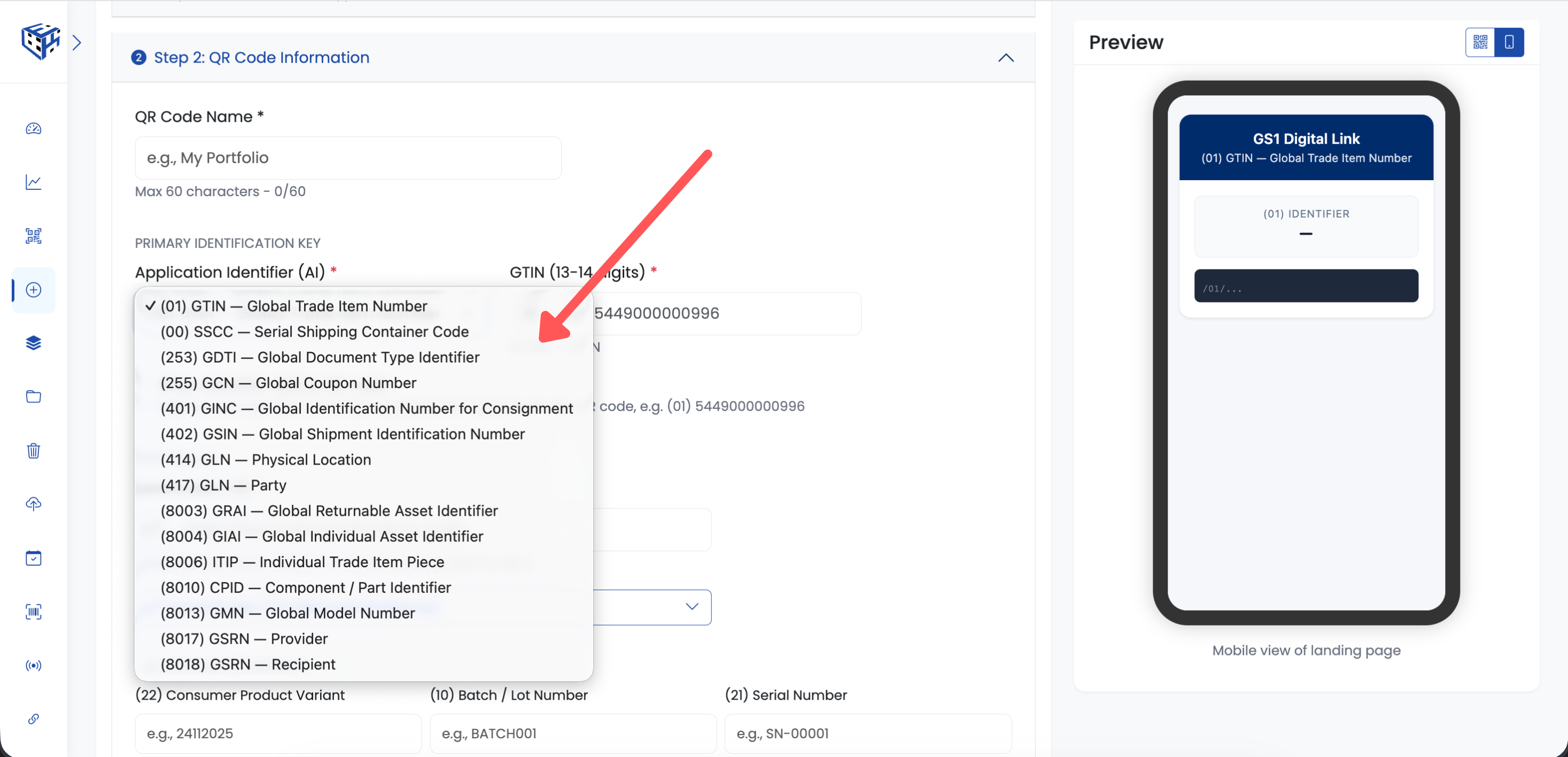
Select from 16 GS1 Application Identifier types in the ElkQR creation form
Product Identifiers
These identify individual products or trade items. If you're putting a QR code on a product that gets scanned at checkout, you'll use one of these.
| Identifier | AI Code | Length | Used For |
|---|---|---|---|
| GTIN-8 | (01) | 8 digits | Small products like magazines, candy bars |
| GTIN-12 | (01) | 12 digits | North American retail products (UPC) |
| GTIN-13 | (01) | 13 digits | International retail products (EAN) |
| GTIN-14 | (01) | 14 digits | Outer cases, cartons, pallets |
GTIN-13 is the most widely used globally. If your product is sold in retail stores, this is almost certainly what you need. The number is typically printed below the barcode on your existing packaging.
Logistics Identifiers
These track shipments, containers, and logistics units as they move through the supply chain.
| Identifier | AI Code | Length | Used For |
|---|---|---|---|
| SSCC | (00) | 18 digits | Shipping containers, pallets, logistics units |
| GINC | (401) | Variable | Consignment numbers for grouped shipments |
| GSIN | (402) | 17 digits | Shipper-assigned shipment identification |
SSCC is the most important logistics identifier. Every pallet or shipping container leaving your warehouse should have one. It enables end-to-end tracking from dispatch to delivery.
Location Identifiers
| Identifier | AI Code | Length | Used For |
|---|---|---|---|
| GLN — Physical Location | (414) | 13 digits | Physical locations — warehouses, stores, offices |
| GLN — payTo / Invoicing Party | (415) | 13 digits | Identifies the party to be paid for an invoice |
| partyGln — Party GLN | (417) | 13 digits | Identifies any party in the supply chain |
GLN identifies physical locations in the supply chain. A retailer uses GLNs to identify each store. A manufacturer uses them for each warehouse. When combined with GS1 Digital Link, a GLN QR code on a warehouse wall can link to facility information, safety procedures, or delivery instructions.
Asset and Document Identifiers
| Identifier | AI Code | Length | Used For |
|---|---|---|---|
| GRAI | (8003) | Variable | Returnable assets — pallets, kegs, gas cylinders |
| GIAI | (8004) | Variable | Individual assets — equipment, vehicles, tools |
| GSRN | (8018) | 18 digits | Service relationships — subscriptions, memberships |
| GDTI | (253) | Variable | Documents — invoices, certificates, permits |
| CPID | (8010) | Variable | Component parts within a product |
| GMN | (8013) | Variable | Global model numbers for product models |
Check Digit Validation
Every GS1 identifier includes a check digit — the last digit that validates the rest of the number. ElkQR calculates and verifies this automatically. If you enter a GTIN with an incorrect check digit, ElkQR will flag the error before generating the QR code. This prevents invalid codes from reaching your products.
Tip
Not sure which identifier to use? For retail products, start with GTIN-13. For shipping, use SSCC. For locations, use GLN. These three cover 90% of use cases.
Related Articles
Still facing difficulties?
Click here to contact our support team for assistance